Image credit: Wikimedia, Canva
A version of this article was originally published by The Canberra Times.
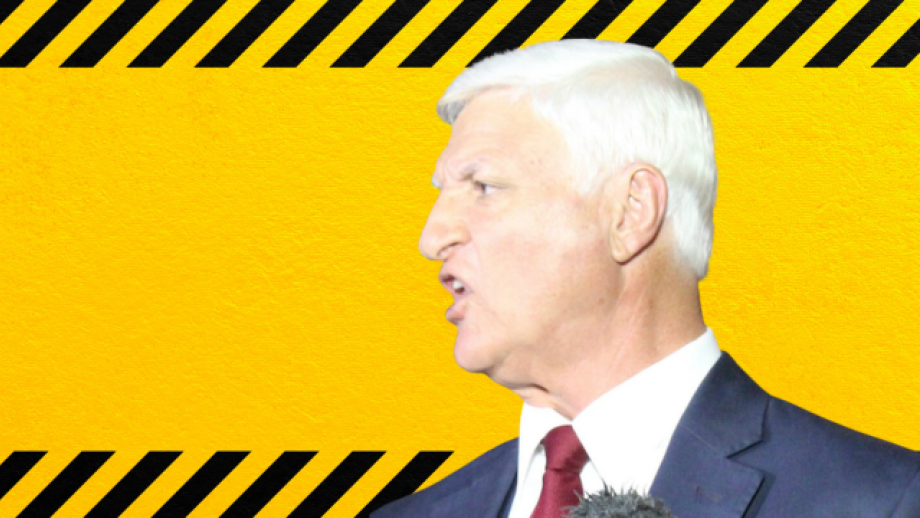
Two decades ago, Bob Katter began warning of an upwelling against the political mainstream's affection for privatisation, free trade, and globalisation.
The nativist Queenslander was so convinced that a pitchfork rebellion was brewing that at one point he called a press scrum into his Parliament House office, to warn that a shadowy "beast" was stirring. Soon it would monster the Labor-Liberal duopoly.
It was among the most bizarre, ethereal pressers I ever attended, pipped only by the circus of Clive Palmer jointly appearing with Al Gore.
In the current lingo of the fringe-o-sphere, that major-party duopoly is derided as a "uniparty". Its adherents insist that the big parties exaggerate their differences while actually being in cahoots. Invariably, the arguments goes, they will side with corporate and elite interests rather than ordinary folk.
It's a seductive idea as living standards decline and problems accumulate. And it is not without material examples - take electoral laws designed to favour incumbents, a toothless anti-corruption watchdog, and now, gambling reform to which I'll return below.
Somewhat ironically, the uniparty terminology beloved of "real" patriots and anti-globalist conspiracists, is imported from the US and UK. Nationalism, it turns out, is globally linked and funded.
Far-right populists are forever flying business class to each other's shindigs to perfect fundraising and disinformation practices, and to commune on podcasts, conference stages, and television programs.
That said, a more good-natured cynicism around institutional politics has a long history in Australia.
"It doesn't matter who you vote for, a politician always wins" joked one man light-heartedly to my dad while queuing at a polling booth in the 1970s.
With its turf roof, the architects of Parliament House even engineered Australian scepticism right into the building. The design symbolised the idea that our politicians should never forget that the people could walk above them. Sadly, security concerns put paid to that reality.
Searching back, there are few accounts of Katter's oddly theatrical press call, but his words to an ABC radio interview covered the same material.
"What we have here is a beast that's been slumbering and is now lumbering out of his cave, and he's got his club and there's a lot of people out there that he's going to whack," the colourful MP had said.
Katter's "beast" failed to materialise at the time but if you were trying to describe the reawakening of a dormant One Nation in 2026, you could do worse than to dust-off his imagery of a righteous monster on the tear.
Retain that mental picture and weigh it against a less graphic observation from the conservative intellectual, Paul Kelly, who recently declared incrementalism was dead.
Between Katter's plebian uprising and Kelly's admission that the procedural minimalism of post-war governing no longer cuts the mustard, stands a conventional Labor government, re-elected just last year with a colossal majority.
So, how is it adjusting to this historic conjunction of a huge margin, another two years to an election, and a clear public disdain for words in lieu of action?
The short answer is, not swiftly. Even Liberals wonder at its tendency to place each-way bets. As one told me on Friday, Albanese Labor looks at every problem and works out what is the least it can get away with doing to neutralise it. The Liberals cited as examples the PM's stubbornness against a royal commission after Bondi (until forced), and his current refusal to stiffen gambling laws even when voters want it.
Others on Labor's left flank have been clearer still. "Just read the room," proclaimed an exasperated Greens senator, Sarah Hanson-Young ahead of last week's parliamentary inquiry into Labor's timid and friendless package.
Labor's threat to walk away rather than accept a toughening of its legislation is dangerous brinkmanship. It suggests it doesn't take the reality of social harms from gambling very seriously. Big mistake.
Albanese took a well-earned break over recent days so it will be interesting to see what, after reflection, he makes of the way problems have suppurated in his absence - migration policy, gambling reform, significant cuts to the NDIS.
The first of these, migration, is being driven not by the government nor even by the Coalition but by the right-wing fringe.
It is telling that after four years in office, sharp cuts to the aggregates of net-overseas migration are suddenly an urgent priority. So urgent in fact that Immigration and Citizenship Minister, Tony Burke had to postpone a planned speech to the National Press Club because of last-minute Cabinet arguments over the details.
This PR debacle was an apt demonstration of the disruptive force now dragging both the opposition and the government to the right.
It invites an uncomfortable question: who, currently, is Australia's most powerful figure when it comes to the crucial area of population policy? Is it the Prime Minister, or Burke? Or is it a hard-right minor party senator?
In the other two areas, the government's instinct is also to skew rightward as if this is exclusively where any threats in 2028 will originate.
But is that right?
Mark Kenny is the Director of the ANU Australian Studies Institute and host of the Democracy Sausage podcast.