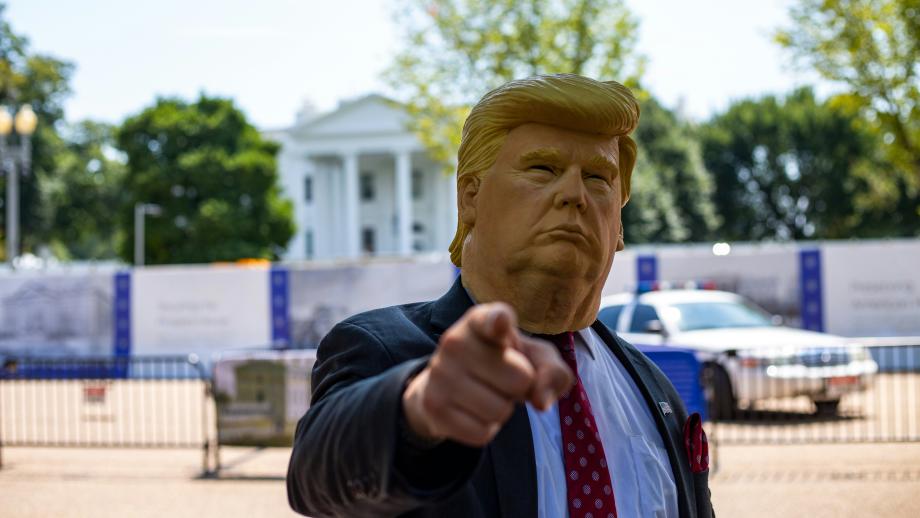
Photo by Darren Halstead on Unsplash
A version of this article was originally published by The Canberra Times.
Critics of the comforting hope that America would go to war for Australia cite the competing national interests weighing on the White House at the time.
Essentially, the argument goes, in our moment of peril (or Taiwan's, come to that), Washington would rank the 'realpolitik' of voter opinion and its own strategic calculus far above international friendship.
As persuasive as this is, a more 'materiel' barrier to American willingness already exists.
That of depleted munition stocks, ageing platforms, and yawning logistical incompetence. If the hubristic faces of either Donald Trump or Pete Hegseth have jumped into your mind's eye, you are following me just fine.
Launching bone-headed wars without consulting treaty partners, the UN or Congress, is a risk factor which, if it was ever considered, has just shifted from future-notional to present-observable. More on this shortly.
Besides, even under the most multilaterally minded US presidents, the actionability of obligations to consult under ANZUS and any implied oneness within AUKUS leave wide scope for cogitation.
That was always true, but the (re)arrival of the impulsive Donald Trump in 2025, has made such truths (to quote a president whose name adorns an unhappy USS aircraft carrier in the Middle East) self-evident.
Trump's success is his country's signature failure. He has forged an America in his own image - bloated with unjustified self-regard. It is an unashamedly self-interested America - if not precisely isolationist.
Trump would feel no obligation to a close ally, regardless of treaty expectations and regardless of Aussie blood and treasure committed in Vietnam and Iraq or the sole invoking of the ANZUS Treaty (by John Howard) after September 11.
Further, it would be naive to imagine things will revert after this presidential term. Trump's 'Don-roe' stance has reset public opinion. It will remain a dominant driver of foreign and strategic policy long after he leaves.
Trump has made America weaker in a multitude of ways. First, his war on Tehran has achieved the opposite of its specific objectives and its broader projection of US strength. Six months into his four-week war, the regime in Tehran remains in situ and more determined than ever. It can and will outlast America.
It is timely to be writing about this human rights morass on the fifth anniversary of America's betrayal of Afghanistan - a war justified by George W. Bush and his wife as the delivery of women and girls from a murderously misogynist Taliban.
The American retreat two decades later was so craven that America acceded to a Taliban demand that women be excluded from peace talks even as their lives and rights were annihilated.
Among the tragic sequelae of America's longest entanglement are 47 dead Australians and the unchallenged authority of the Taliban as females are denied education, imprisoned and starved. That feckless retreat emboldened Putin's calculation that America would not intervene even if he invaded Ukraine.
In Iran, Trump's first rationale was the removal of the mullahs and the decapitation of oppressive regime such that Iran's long-suffering dissidents could step into the vacuum. He encouraged them to stand up and take the names of their oppressors. Amnesty reports that 26 of these brave dissidents have since been executed. More will follow.
Regime change faded as it was replaced by the obliteration of Iran's nuclear weapons program and then by the re-opening of sea lanes. Five days ago, Trump declared that Hormuz was now fully under the control of the US Navy. Except that it wasn't. It was the seventh time Trump has claimed victory, imminent peace, complete mastery of the waterway.
The trouble with rhetoric is that it always requires escalation. Thus, in a speech to a Police Academy in Long Island in the last 24 hours, he went further: "After we finish defeating Iran ... I'll be declaring the Hormuz strait a territory of the United States."
This is the official policy of Australia's chief ally, its dependable, principled friend.
Perhaps, you counter, that even with these imperfections, there is still no gainsaying American military superiority?
Here, the evidence is looking dire also. Two US military-aligned newspapers have reported that conditions on the aforementioned USS Abraham Lincoln - which has not made port since November last year (a modern record) - are feral. Hot water has failed and food has been rationed. There is no toothpaste, soap or deodorant. The stress has led to brawls and at least two suicide attempts. Discipline is breaking down.
Secretary of War Hegseth dismissed the claims as "completely misrepresented".
On August 6, a furious Trump took to social media to deny other media reports of diminishing US fire-power as missile demand in the Middle East outstrips supply.
"The US has massive amounts of 'munitions' ... the 'leakers' are treasonous and will be hunted down. Long-term jail sentences will be sought".
As always, Trump's temper takes you closer to the truth than his words.
Patriot missiles and other interceptors cost $5 million each and it often takes two of them to destroy a single incoming missile.
If the US has already eroded its stocks of Patriots, THAAD, and the other sophisticated interceptors against Iran's ballistic-trajectory missiles, how long would it hold out against another super-power?
Mark Kenny is the Director of the ANU Australian Studies Institute and host of the Democracy Sausage podcast.