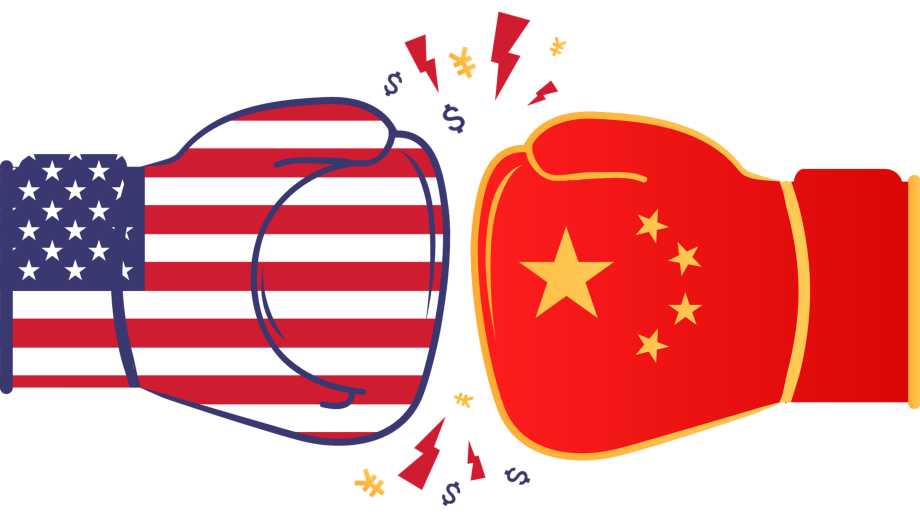
Image by Priyam Patel from Pixabay
By Mark Kenny
A version of this article was originally published by The Canberra Times.
When Donald Trump and Xi Jinping emerged from their "historic" talks in Busan, South Korea on Friday, there were enough wins for both sides to claim success.
China had "paused" its restrictions on rare earth exports and agreed to buy American soybeans while America had wound back punitive tariffs.
But what about the underlying forces driving these frictions, the defining great power rivalry of the 21st century? Who has emerged with the greater leverage for the inevitable contests to come?
Was it the world's apex military power, builder of alliances and guardian of the liberal order?
Or was it the coming giant? On this score, things are less favourably poised for the US.
According to the well-known "Thucydides trap" theory, when a dominant power is met by an emerging one, war becomes likely, if only because of irrational fears inspired within the dominant power.
Irrational fear bringing irrational responses. America bristled with indignation at Beijing's rare earths ploy (announced just two days after Trump's Liberation Day tariffs and added to more recently) but had felt entirely righteous in withholding semi-conductors and other technology from Huawei in 2019.
Yet, even Trump may now accept that America, that great factory of ideas, innovation and global leadership since 1945, has stalled, and it is China now forging ahead.
There's a sense that for all his "world's biggest and best" boasting, Trump would settle for a post-global foreign policy reminiscent of the old 'sphere of influence' thinking during the Cold War period.
Or, as one distinguished figure put to me this week, "Trump's conception of China and Russia is basically that it is business, as if, like Mob bosses, he's saying if they stay on their turf, they will do what they will do".
Viewing Trumpism through this lens offers some level of coherence to his erratic pre-occupations like acquiring Greenland, Canada, the Panama Canal. And to interfering in Venezuela, where he has the CIA acting in-country and where the US Navy is involved in extrajudicial killings of alleged drug-runners in fast boats. This is America's backyard.
For Australia, this matters, although not necessarily in ways you might immediately nominate. We'll come back to that.
Trump beamed going into the bilateral meeting with Xi - their first face-to-face in six years - and tried to beam just as enthusiastically coming out, shaking the Chinese autocrat's hand as he flashed his car-dealer's smile for the cameras. The American's fulsome praise served mainly to convey relief, itself a tacit admission that his bellicose trade policies had backfired.
Much worse though, Trump's bravado against Beijing had clumsily shifted the balance of the game in Xi's favour by inviting him to weaponise rare earths exports on which the US remains critically dependent.
Even after being paused, the punitive restriction of rare earths supplies to the US is now the new-normal - a permanent contingency applicable at any moment.
Perhaps that is why emerging into the light, the Chinese leader kept his own counsel, his face a carefully measured rictus, his lips pursed just on the right side of grimace.
That the detente achieved in South Korea is fragile goes without saying, especially as both sides are as inclined to displays of strength - for domestic purposes - as they are hypersensitive to insults.
These are never far away.
A reminder of this came just minutes before the talks, strangely enough, with Trump boasting on social media: "The United States has more nuclear weapons than any other country ... Russia is second and China is a distant third ... Because of other countries' testing programs, I have instructed the Department of War to start testing our nuclear weapons on an equal basis. That process will begin immediately," he wrote on his platform Truth Social.
So, just as trade tensions were easing, fresh developments arose in nuclear proliferation and the security domain.
This brings us to Australia's delicate balancing act as a close security confidant to Washington and an economic codependent with Beijing.
Here, the challenges within what is broadly framed as our "national interest", combine as if oil and water.
Almost uniquely, Anthony Albanese has managed both relationships with considerable skill and done so simultaneously. His visit to China in July was hailed as a success as was his October visit to the White House.
And it was at this bilateral meeting that Trump revealed something germane to all three nations - China, US, and Australia.
Asked about AUKUS, the major attraction for which, in Washington at least, is the imminent prospect of China moving militarily on the island democracy of Taiwan, the President gushed with undue confidence in the pact before adding, "I don't think we're going to need it ... I think we're going to be just fine with China".
For at least the last decade, the likelihood of the US going to war with China over Taiwan has provided the agreed arena of discussion. It has shaped defence policy thinking and at times has broken out into partisan politicking such as in 2021 when Peter Dutton described the idea of Australia not joining America in such a conflict as "inconceivable".
Trump seems to have dismissed the idea of it happening at all, and one suspects would show no interest if it did.
Mark Kenny is the Director of the ANU Australian Studies Institute and host of the Democracy Sausage podcast.