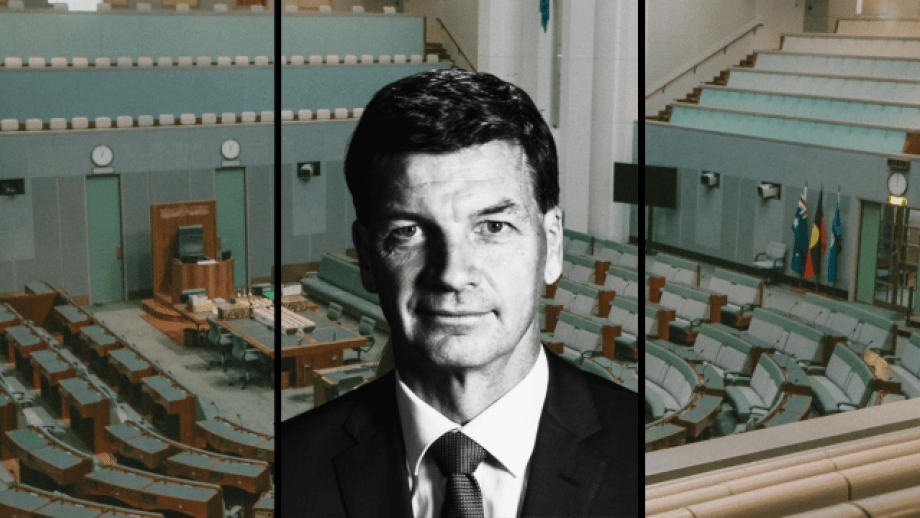
Photo credit: ANNIE HATUANH on Unsplash, Wikimedia
By Mark Kenny
A version of this article was originally published by The Canberra Times.
Politically speaking, Angus Taylor is a dead man walking.
The country-based leader's insistence on ending Sussan Ley's leadership has proved to be a crucial miscalculation - especially if he assumed she would not quit Parliament.
His judgement of the electoral mood was shown to be entitled, and flat-out wrong.
Principled Liberals now face a stark choice between certain failure under the status quo and the risk of even greater chaos if they tear him down in favour of the protectionist anti-market West Australian, Andrew Hastie.
Farrer failure is grist to that mill.
The Liberal Party - referred to by Christopher Pyne only a few years ago as "an election-winning machine" looks cooked - tumbling from its unique role as the most successful party of government since WWII, to bit-player. Historical footnote.
The election of the 69-year-old One Nation convert, David Farley, in a safe Liberal seat is a depth-charge under Australian politics and signals a permanent realignment of conservative rivalries.
The implications for Taylor's party are dire but the ramifications for Australia, its globally admired multi-culturalism, its famously non-discriminatory immigration policy, its open celebration of diversity, are huge.
One Nation is now ascendant - invited into the circus tent of Australian parliamentary possibility by a craven Coalition, unable to find the moral resolve to call out its racism as John Howard, and every conservative PM since, had done.
As the ABC's Casey Briggs has noted, Farrer was the first time in Australia's postwar political history that none of the major parties was represented in the first two placed candidates in a federal seat.
When Howard's unpopular government looked like losing the looming 2001 election, he lauded an unlikely win in the Aston by-election that year, declaring if the people wanted to see the end of the Liberals, "they would have rolled us over in Aston". He was right and went on to win that general poll.
Taylor represents the reverse scenario. If he was to have any hope of reviving his beleaguered party's stocks after it surrendered so many seats in urban Australia, then the RM Williams-wearing leader needed to hold on to a regional jewel the coalition has owned since 1949.
He wasn't even in the race.
Taylor is Australia's Keir Starmer. Like the embattled British PM, he is a leader with no reason for being and no realistic hope of becoming PM.
His preferencing of One Nation will be synonymous with his party's rapid, unchecked descent into the morass.
One Nation's rise was not inevitable, nor impervious to critique. If the odious influence of billionaire-linked populists is to be defeated, it required clear, principled, contestation, not appeasement.
Australia's established parties should have taken a leaf out of the books of centre-connected parties in the Netherlands and Germany where right and left have acted in unison to defeat extremism, racism, religious intolerance, and division.
As Winston Churchill told Neville Chamberlain: "You were given the choice between war and dishonour. You chose dishonour, and you will have war".
Mark Kenny is the Director of the ANU Australian Studies Institute and host of the Democracy Sausage podcast.